
Redefining the Regency
Do I love Regency Romance?
Yep.
Dashing dukes in cravats, horseback rides in Hyde park, courtly love at a ballroom crush?
Swoon.
Would I time travel to England in the early 1800s?
Hell no.
Some of you are with me on this. The idea of a chamber pot alone is enough to make us sidestep Michael Crichton with a hearty, “Thanks, but no, bro.”
I love my husband (even though he’s not an earl) but I don’t want to be his lawful property or give up my own bank account because I’ve got a vagina.
Still, more of you are like, “C’mon! I’d trade modernity for a houseful of servants in Mayfair and a waltz with Viscount Bridgerton any day.”
And you wouldn’t be alone. There’s something about Fabio’s famous pecs and the England of 1811-1820 that makes us drool. And, of course, pick up a book.

📖 Enter the bodice-ripper
I’ve loved Regency novels since I was old enough to have my mom introduce me to the sweet-tempered handwriting of Georgette Heyer. After I devoured all the chaste kisses and happily ever afters, I promptly climbed our bookshelves to pull down every bodice-ripper I could find.
In high school I tore off the covers so I could sneak them into AP English and read a steamy chapter in between Austen, Hawthorne, and Billy Shakes.
I’ve read hundreds of books, but I keep coming back for a tasty historical romance. Give me anything pre-1900 and I’m inhaling it. Jennifer Ashley? Nom, nom, nom.
So what is it about this tiny time period that causes us to lose our minds over cravats and empty our reticules of pin money at the bookstores?
🕰️ Here’s what I’ve come up with in my time travels:
Respect the “blip.”
The Regency was just shy of a British history decade. A sneeze, if you will, that takes place in the midst of everything else you could study about Great Britain, it occurred from 1811-1820 when “Mad” King George III became so mentally ill that Parliament deemed him unfit to rule.
The Royal Mum had borne the country fifteen children, but because of bureaucracy and unromantic 1800s primogeniture laws, the reins to the kingdom skipped Queen Charlotte and went to her first and most bestest creation: the Prince of Wales. Her son (fun fact, he was also named George, because why get creative?) would rule the country as “Prince Regent” in his father’s stead, thus ushering in the age known as “The Regency.”
Portly, pampered Prinny created a “sandwich” generation that squeezed itself between the end of the stuffy 18th century (think powdered wigs and Marie Antoinette) and the morally strict, technologically advanced Victorian Era.
And because it all occurred within a snap of Thanos’s fingers, the Regency functions as a multiverse thread of hyper-focused fashion, sharp wit and intense social maneuvering we continue to marvel at to this day (see what I did there?)
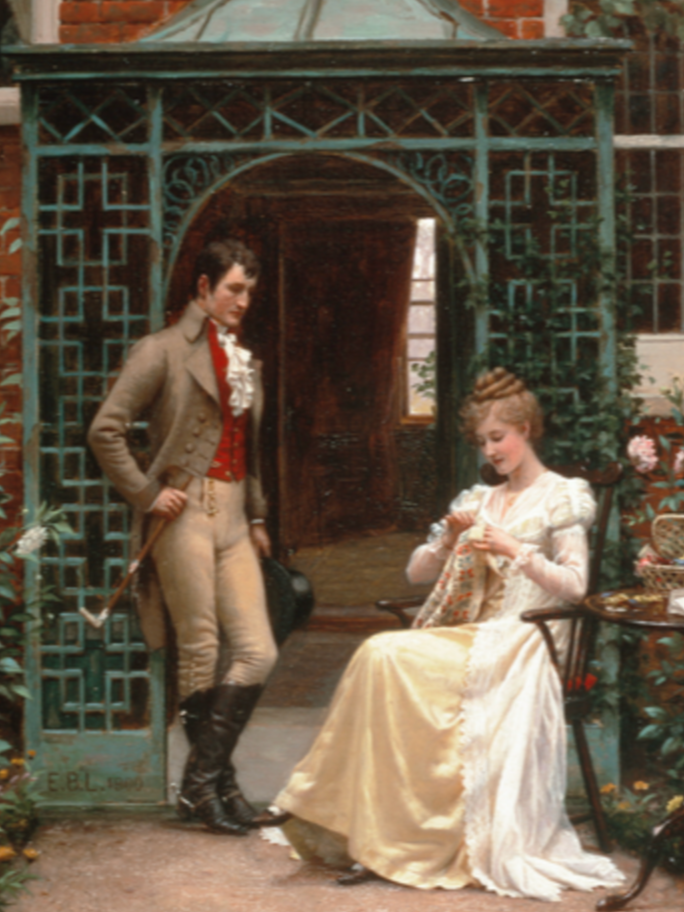
“I am aggressively embroidering so I don't have to make eye contact with a man who lacks a 10,000-a-year estate.
🖤 So why choose it as a destination?
Tortured repression is romantic. The absurd social etiquette of the era meant that a single glance over a fan, or touching hands without gloves, or ditching your chaperone to sneak into the garden for a peck on the cheek could change your life. For better or worse. ‘Til death do you part. Forced marriages to hot earls? See where I’m going with this?
The cutie on the dance floor can’t come over and say hi without an invitation. If no one offers it, you’re left pining with the other wallflowers drinking punch. Burning, wallowing, yearning, the Regency delivers all the passionate frustration of a teakettle set to slow simmer.
Subtext is everything. When a single carriage ride could change a woman’s destiny, the everyday events in your love life carried substantially more weight. Since lovers couldn’t always speak their minds, every conversation about watercolors to the weather is a multi-layered duel of flirting and fawning.
High stakes hijinks. We love rule-breakers. And in 1811 women’s rights were…
Ha, ha, ha, that’s so funny… women’s rights… let me wipe this tear away for a second…
Okay, so there weren’t many. But limited choices creates delicious excitement; it entices us to wonder what it’d be like to exist in the early days of Pride and Prejudice.
If you time-traveled, you could be the one to defy the expectations. You’d survive the unfairness of the world, and you’d conquer it. (And maybe fall scandalously in love while doing it.)
Intellectual food fights. My personal favorite discovery. People usually love or hate Jane Austen for the same reason. Witty banter using big words. The Regency lets us watch two people duke it out (pun intended) with their clever minds while staying within the ring of politeness.
Give me a big vocabulary along with that big… well, you know, and I’m totally hooked. Just don’t call me out for pistols at dawn.
Pick your chili pepper. Since PDA was a no-no, when we think of the Regency, there’s a smorgasboard of heat options for romance. Because the social expectations allowed only chaste kisses and babies miraculously appearing without detailed mechanics, everything else was solidly behind a closed door.
Which makes us want to peep around it. What exactly would a baroness do with her lovers in the bathtub (whenever she happened to bathe)? I’m sure even Miss Austen would approve our curiosity. She did like a spicy female character.
Can I get a HEA? Any way you slice your regency pie, you’re sure to get the dream of a happily ever after. No matter how hard the intellectual bickering, the social etiquette flaunting, or the emotional repression, everything’s going to work out rainbows and unicorns by the end. It has to. The Regency was all about marriages, babies, or continuing adventures—all the sweet feels. Which is probably the best reason yet to get on board as a reader, author, or arm-chair time traveler!
⏳ What is your favorite thing about the Regency? Broody dukes, breaking the rules, or repressed passions? Jump to social and let’s chat in the Chrono & Quill community!
